Introducing ResearchRadar: the radar, not the firehose
ResearchRadar watches the research and technology landscape around the R&D problem you are actually working on. Instead of another feed to search, it delivers the developments that matter, with source-backed evidence and a calibrated TRL score.
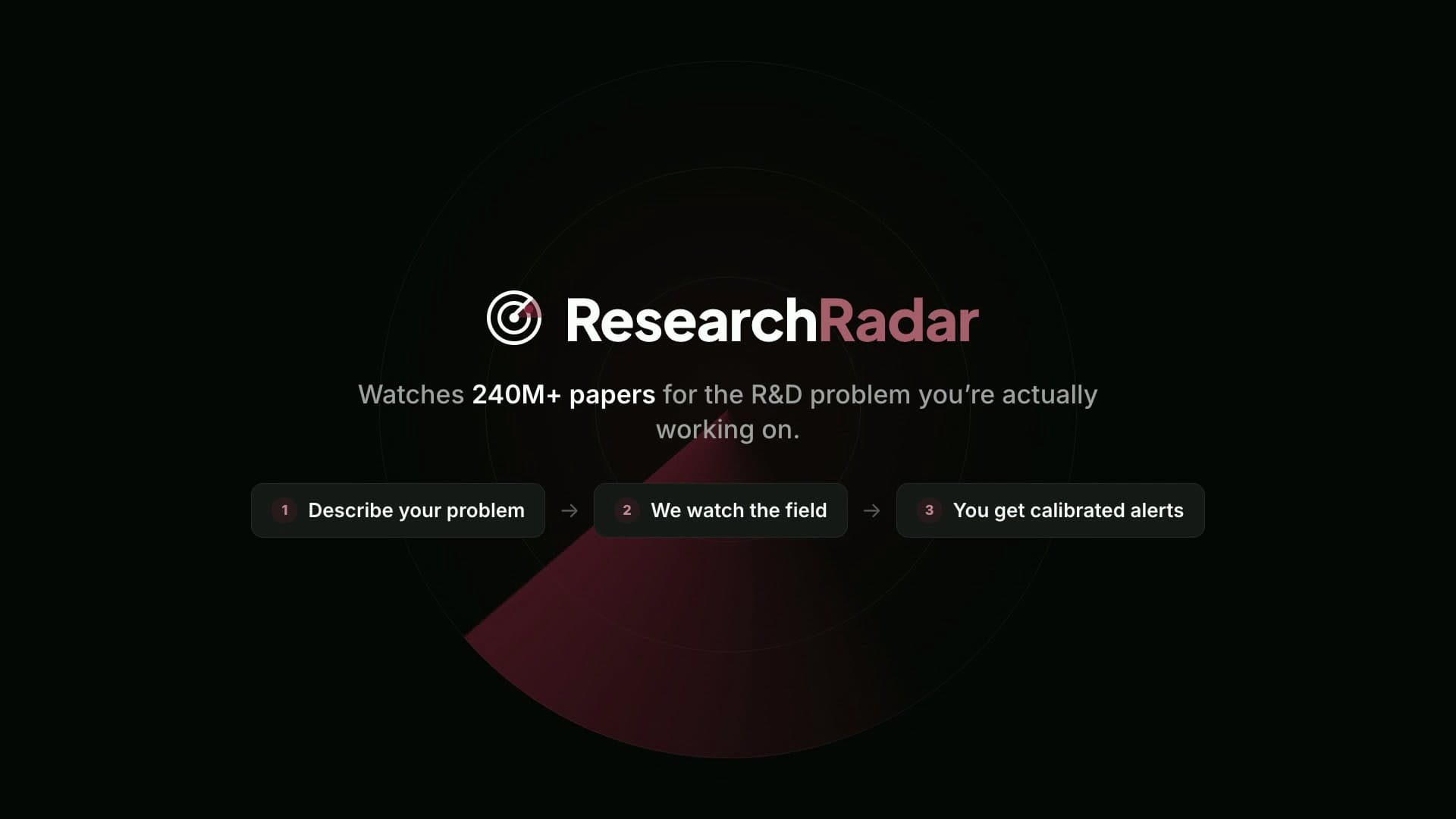
Research moves faster than any team can read. The hard part is not finding more papers; it is knowing when something changes around the R&D problem you are already working on — and being able to see why it matters.
That is what ResearchRadar is for. Give it the document that defines your work, and it watches the field around it. When a relevant paper, organization, or weak signal appears, the radar gives you the connection and the evidence behind it.
Watch the trailer
From document to a live radar
The workflow starts with the work you already have: a thesis, proposal, paper, or technical brief. ResearchRadar reads it into a structured representation, keeping only facts it can support with a quote from the source. That evidence becomes the context for the radar.
From there, ResearchRadar watches for movement: a paper matching your problem, an organization publishing in your overlap, or an emerging combination of topics that is starting to gather momentum. The point is not to replace your judgment. It is to make sure important movement reaches it early.
Evidence first, not a black-box feed
An alert should answer two questions: why am I seeing this? and what can I check? ResearchRadar is designed so the answer points back through the document facts and source quotes behind the match.
That makes the product useful in the moments when a generic recommendation is not enough: deciding whether to investigate a new result, discussing a technology's maturity, or explaining a signal to someone else on the team.
The radar, not the firehose
The literature is enormous. ResearchRadar watches more of it so you do not have to. Its job is to turn that scale into a short, explainable stream of developments around your work — not another inbox full of links.
Early access is opening in autumn 2026. Join the waitlist to follow along.
Questions we get
What does ResearchRadar watch?
ResearchRadar monitors research papers and organizations around the problem described in your document. It is designed to surface new work, relevant organizations, and emerging connections as they appear, then explain why each development is relevant to the work you gave it.
What makes an alert trustworthy?
Each alert is designed to trace back to evidence from your source document and the matching development. ResearchRadar keeps extracted facts only when it can retain a verifiable source quote, so relevance is something you can inspect rather than a score you must take on faith.
What is a calibrated TRL score?
Technology Readiness Level, or TRL, is a 1–9 scale for how mature a technology is. ResearchRadar uses a calibrated assessment so its readiness signal is grounded in defined criteria, helping teams distinguish an early research finding from a technology nearer deployment.